
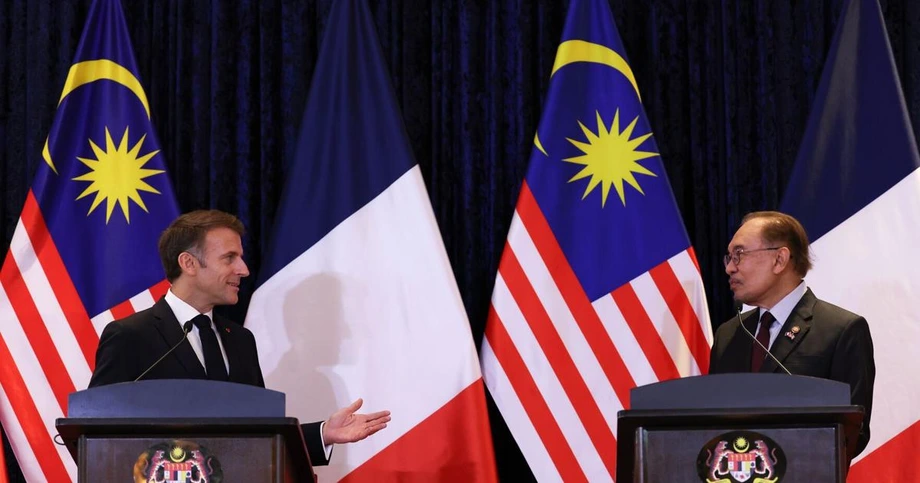
Ein neues Kapitel in den bilateralen Beziehungen
Französischer Präsident Emmanuel Macron und malaysischer Premierminister Anwar Ibrahim gaben einen großen Upgrade ihrer diplomatischen Beziehungen während einer zwei-täglichen offiziellen Reise from November 16 to November 17, 2026. Die Führer trafen sich im historischen Sultan Abdul Samad Building in Kuala Lumpur, um eine breitere strategische Partnerschaft zu etablieren, und legten den Grundsatz für tiefere wirtschaftliche, technologische und Verteidigungskooperation vor dem seventieth Jahrestag der diplomatischen relations in 2027. Der Gesamthandelsumsatz zwischen Malaysia und Frankreich erreichte RM17.78 billion im Jahr 2025, wobei Frankreich als Malaysias twenty-first-largest Handelspartner weltweit und seine fourth-largest unter den europäischen Nationen dient. Mehr als 300 französische Unternehmen betreiben derzeit in Malaysia, unterstützen thousands lokale Jobs und erstrecken sich von Aerospace bis advanced manufacturing.
Inhalt
The visit included seven signed cooperation agreements covering critical minerals, defense industry cooperation, classified defense information, a regional center to address hybrid threats, Royal Malaysian Air Force helicopter procurement, energy transition, and digital connectivity projects such as Project SALAM. Prime Minister Anwar emphasized that the upgraded partnership reflects a shared commitment to mutual respect and tangible economic benefits. President Macron noted that the agreements reinforce the strategic autonomy of both nations in a complex global environment without taking a confrontational approach toward major powers.
Rare Earths and Industrial Exceptions
Malaysia has made a strategic exception to its strict ban on exporting raw rare earth minerals to facilitate collaboration with France. Rare earth elements are a group of seventeen metallic chemical elements crucial for manufacturing high-performance magnets used in electric vehicles, wind turbines, defense systems, and consumer electronics. In 2024, the Malaysian government imposed a moratorium on exporting raw rare earths to protect domestic resources and encourage local processing industries. Under guidelines effective October 1, 2026, enacted by the Ministry of Natural Resources and Environmental Sustainability and the Department of Mineral and Geoscience, the government introduced conditional flexibility for research, development, and processing.
Prime Minister Anwar explained that the policy exception relies entirely on France's commitment to team up with Malaysian workers and transfer valuable industrial expertise. Rare earth elements are mined and initially separated into usable compounds, which prevents raw material extraction without local economic benefit. Malaysia holds vast potential in non-radioactive rare earth elements, with estimated market values ranging between RM747.2 billion and RM809 billion. This mineral wealth makes the country an attractive partner for Western nations seeking supply chain alternatives outside China, which currently dominates global rare earth production and processing.
French company Carester and Malaysian firm Malaco Mining Sendirian Berhad are spearheading the joint rare earth project, with operations scheduled to begin in early 2027. The collaboration builds on an initial partnership signed in July 2025 and involves a separation facility in Malaysia's northern Perak state. Frederic Carencotte, chief executive of Carester, noted that the Perak separation plant will start with an initial annual capacity of 3,000 tonnes before expanding to 13,000 metric tonnes annually. The project covers local extraction and initial processing in Malaysia, alongside reserved volumes and the option for further refining in France to secure the European industrial value chain.
Strategic Defense and Security Cooperation
Defense ties formed a vital pillar of the discussions in Kuala Lumpur, as Malaysia actively diversifies its military suppliers following supply chain disruptions with other Western partners. Defense Minister Khaled Nordin and other senior officials participated in bilateral talks addressing modern security challenges and industrial defense partnerships. President Macron announced that French firm Airbus will supply combat search and rescue helicopters to the Royal Malaysian Air Force, although specific financial terms and delivery schedules were not disclosed during the press conference.
Both governments also agreed to establish a regional center in Malaysia designed to counter hybrid threats, encompassing cybersecurity vulnerabilities, digital disinformation campaigns, and coordinated cyberattacks. Furthermore, the two nations signed agreements concerning classified defense information security and joint defense industry manufacturing capabilities. These defense arrangements arrive as Malaysia reassesses international supply chains, following an incident where Norway revoked an export license for missiles intended for the Malaysian naval fleet, raising local questions about the reliability of traditional foreign defense suppliers.
Semiconductors and High-Performance Computing
Technological collaboration between Malaysia and French enterprises extends directly into advanced semiconductors and high-performance computing platforms. Malaysian semiconductor company SkyeChip will collaborate with French chip designer SiPearl to develop advanced chiplets and high-performance computing microprocessors. Chiplets are modular integrated circuits that allow manufacturers to build powerful processors more efficiently by combining smaller specialized silicon dies rather than printing a single massive chip.
Ambassador Marc Abensour outlined the broader research rationale before the presidential visit, emphasizing that universities and research centers are forging closer ties to support Malaysia's transition from traditional semiconductor packaging into advanced chip design. The cooperation is supported by funding mechanisms aimed at talent development and engineering innovation. Additionally, the French Development Agency is supporting the opening of a School of Regulators in Kuala Lumpur to help formulate policy for complex regional energy and digital infrastructure projects.
Energy Transition and Digital Connectivity
Energy cooperation under the new strategic partnership focuses on renewable energy integration, electricity interconnections, and the potential development of civilian nuclear energy expertise. Prime Minister Anwar actively sought French support for the ASEAN Power Grid, a regional initiative to connect the electricity transmission systems of Southeast Asian nations. This initiative includes discussions regarding a proposed undersea high-voltage cable linking Sarawak to Peninsular Malaysia and Singapore, alongside cross-border electricity infrastructure.
Digital connectivity also received a major boost through an agreement between LitUp Network and Alcatel Submarine Networks to support the SALAM submarine cable project. This undersea cable infrastructure will significantly enhance Malaysia's internet bandwidth, data transmission speeds, and digital reliability. Alongside these infrastructure projects, the France-Malaysia Business Forum hosted dedicated sessions on artificial intelligence infrastructure, cloud security, and aerospace engineering, bringing together industry leaders from both countries.
Timeline of Key Developments
- July 2025: Carester and Malaco Mining sign an initial partnership agreement for rare earth development.
- July 2025: President Macron issues the New York Declaration regarding diplomatic efforts on Palestine.
- October 1, 2026: The Ministry of Natural Resources and Environmental Sustainability enacts conditional export flexibility for raw rare earths.
- November 5, 2026: The Investment, Trade and Industry Ministry announces conditional moratorium flexibility to attract processing investments.
- November 14, 2026: French Ambassador Marc Abensour highlights joint university research and semiconductor design initiatives.
- November 16 to 17, 2026: French President Emmanuel Macron conducts an official state visit to Malaysia.
- November 17, 2026: Malaysia and France elevate bilateral ties to a strategic partnership and exchange seven major cooperation documents.
- Early 2027: Planned operational launch of the joint rare earths mining and processing venture between Carester and Malaco Mining.
The Essentials
- Malaysia and France upgraded bilateral relations to a strategic partnership during President Emmanuel Macron's visit on November 16 and 17, 2026.
- Malaysia made a conditional exception to its raw rare earth export moratorium to allow joint development with French specialists.
- Carester and Malaco Mining are developing a rare earth separation plant in Perak with an eventual capacity of 13,000 tonnes annually, set to begin operations in early 2027.
- Seven major cooperation agreements were signed, spanning critical minerals, defense procurement, hybrid threat countermeasures, semiconductor chiplet design, and submarine cable digital connectivity.